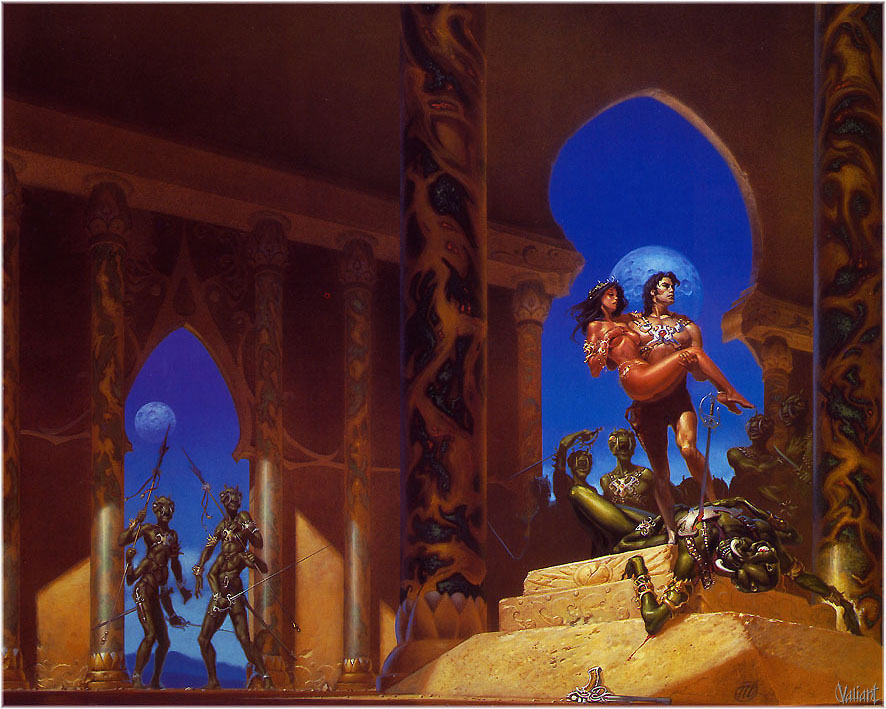
As they worked, Case gradually became aware of the music that pulsed constantly through the cluster. It was called dub, a sensuous mosaic cooked from vast libraries of digitalized pop; it was worship, Molly said, and a sense of community.
from Neuromancer, by William Gibson.
I want to point out a great new CBC radio documentary about dub music. You can listen to it at the Inside the Music Audio Archive - it's called Jamaican Echoes, and it's about an hour long. It does a good job of explaining what dub is, how it developed, and how it spread around the world. Dub techniques and innovations created by Jamaican artists went on to influence huge swathes of contemporary music, from hip-hop to disco to punk to bhangra, not to mention most any style of electronic music you care to mention.
I would've liked some mention of nyabinghi drumming but I suppose that would involve explaining lots of other facets of reggae music. It's a great introduction nonetheless, and includes excerpts from many classic tracks. Be sure to crank up the bass before you listen to it, or you'll miss the point entirely.
I can't be entirely sure, but I think my first introduction to dub was reading Neuromancer, so I've always been focused on both the mystical and science-fictional elements of the music.
PS: For further exploration of the original dub remixing process, you might want to check out this podcast. It contains 21 different versions of Jackie Mittoo's Drum Song.
Monday, December 08, 2008


Monday, December 01, 2008
Robinson interview
Here's a rewarding interview with Marilynne Robinson, the Pulitzer-prize winning novelist. As the introduction says, she's "a Christian whose faith is not easily reduced to generalities." Indeed. Aside from being a very good writer, I think I would describe her as a philosopher; someone who loves knowledge and is deeply interested in reality in all the ways it comes to us. I'm posting the link here because she talks about both science and religion.
On religion:
Religion is a framing mechanism. It is a language of orientation that presents itself as a series of questions. It talks about the arc of life and the quality of experience in ways that I’ve found fruitful to think about.
Or:
The first obligation of religion is to maintain the sense of the value of human beings. If you had to summarize the Old Testament, the summary would be: stop doing this to yourselves. But it is not in our nature to stop harming ourselves. We don’t behave consistently with our own dignity or with the dignity of other people.
On science:
I read as much as I can of contemporary cosmology because reality itself is profoundly mysterious. Quantum theory and classical physics, for instance, are both lovely within their own limits and yet at present they cannot be reconciled with each other. If different systems don’t merge in a comprehensible way, that’s a flaw in our comprehension and not a flaw in one system or the other.
...Science is amazing. On a mote of celestial dust, we have figured out how to look to the edge of our universe. I feel instructed by everything I have read. Science has a lot of the satisfactions for me that good theology has.
And:
I’m not terribly persuaded by the word supernatural. I don’t like the idea of the world as an encapsulated reality with intrusions made upon it selectively. The reality that we experience is part of the whole fabric of reality. To pretend that the universe is somewhere else doing something is really not true. We’re right in the middle of it. Utterly dependent on it, utterly defined by it. If you read somebody like Wallace Stevens, he’s basically saying the same thing.
She also talks about the relationship between religion and science, about beauty, about Lincoln and Marx, about "puritanical hedonism," and well, lots of other things.
Saturday, November 29, 2008
Tidbits
Wow, November has been a quiet month around here. But any of you who've been university students can understand why, I'm sure.
Åka has kindly pointed out two posts from Auxiliary Memory, the blog of James Wallace Harris. In Defining Science Fiction he attempts that notoriously slippery task and describes science fiction as a belief system, much like religion. Interestingly, though, while he is an atheist who prefers sci-fi to religion, he doesn't mean this in a triumphalistic way. Actually he's somewhat ambivalent about it, feeling that science fiction can lead a person away from reality just as much as a religion can. In the previous post, The Children of Science Fiction, he mused about the way reading science fiction can shape a person's worldview: Åka contributed some comments to that one. These are profound questions (I personally think there's more overlap or synthesis between systems) but frankly I don't feel I have the spare brain cells to wrestle with them right now - or perhaps I should say wrestle with again, right now.
Lately when I haven't been reading about literate medieval heretics, politics, or Guatemalan atrocities, I've been privileging comic books over science fiction or fantasy. It's really astonishing how many comics you can read when you should be doing homework. It's also amazing how many trade-paperback comics you can get from the Winnipeg Public Library system, too. (Libraries = cheap as free!) One great source of recommendations (besides Holy Heroes!! of course) has been Say It Backwards, a blog devoted to all things Superman. Check out this post on the ten most important stories for understanding what Superman's all about. Also the best Superman stories since 1985.
When I do get around to reading science fiction again, Anathem is at the top of my list. Here's Gabriel's glowing review, subtitled "all books should be about monks that live inside a giant clock." Right on, brother. Just don't forget the space princesses.
PS: Here's some fascinating news. Black holes are not scary things that are trying to kill us, but are in fact a stabilizing force on galaxies. "The powerful black holes at the center of massive galaxies and galaxy clusters act as hearts to the systems."
Other news: An eleven-thousand-year old temple has been discovered! Paging Indiana Jones!
Thursday, November 13, 2008
Speculative newspaper
This qualifies as speculative fiction: as you may have heard, a 'special edition' of the New York Times was released yesterday. Hundreds of thousands of copies were handed out in New York and Los Angeles, and an online version has been put up. Readers were astonished to discover that American troops would be pulling out of Iraq immediately, that the "United States National Health Insurance Act" had been passed, and so forth.
Of course, none of these things are actually true - at least, not yet. The paper and website were put out by a large alliance of activists, spearheaded by those infamous pranksters The Yes Men (I believe Gawker.com was the first to offer evidence of this). The fake Times is something like the Google News good news page, except that it offers (indirectly) more concrete proposals as to how the changes described might actually be achieved (usually grassroots organizing is involved.)
To tie this speculative newspaper into the theme of this blog, here's an article with a religious connection:
American Evangelical Churches Announce New Policy of Sanctuary for Iraqi Refugees
The author? One "W. Wilberforce!" Well, William Wilberforce, the devout Evangelical politician, is long dead, but his fame as a mighty and tireless campaigner for abolition, animal welfare, and other social causes still lives on. I imagine most of the by-lines in the newspaper are of this nature. One public statement about the special edition came from a "Bertha Suttner," who is also a long-dead activist.
The "ads" in the online version are also worth a close inspection: apparently ExxonMobil is adopting bold new environmental and social policies, American Apparel is unionizing its half-naked waifish models, and GM is bringing back its electric car, the EV1. I particularly liked the ad for a dermatologist who is putting aside his 'superficial services' in order to collect donations for rebuilding Iraqi schools. The slogans: "Be beautiful on the inside as well as on the outside!!!" and "Now you can have... A BEAUTIFUL CLEAR CONSCIENCE."
Thursday, October 30, 2008
Harry Potter to be investigated?
Yes, another overly literal person has become mighty suspicious of that no-good Harry Potter and similiar characters. He hasn't actually read any of the books, but he thinks they may very well have a "pernicious" and "insidious" effect, because they may teach children to believe in magic. He is a bit better than most other fundamentalists in that he admits that he doesn't know for sure... yet. But like a good evangelist, he intends to write his own book for children to instruct them in the orthodox way.
I'm not sure what he'll think of the magic if he does get around to reading the Potter books. He'll probably approve of the magisterial British academics portrayed therein, but he'll likely be unhappy with the fact that the children spend much of their time disobeying said academics. And if he makes it to the final book he'll probably get very angry when he comes across the Christian symbolism it contains. (My thoughts on The Deathly Hallows are here.)
Alan Jacobs comments snarkily here.
Friday, October 24, 2008
The Blob, harbinger of theocracy
I don't think I've ever seen this (sort of famous) monster-from-outer-space movie. Apparently a recent book by Jeff Sharlet connects it with a shadowy world of theocratic fundamentalism, Cold War anti-communism and American neo-imperialism. Rudy Nelson, who worked on the film, thinks Sharlet makes some good points but that he's wrong about The Blob (and some other things).
Well, I haven't seen it, and this kind of thing is not exactly in my purview. It's more B-Movie Catechism territory (although The Blob might be too upscale for his tastes...!) Anyways, I'll just leave you with this amusing quote from Nelson's article:
But now it was high time for us to fill a serious scripting gap. We knew how the film would end (for sure, not by blowing up the town). An Air Force cargo plane would drop the frozen, cut-up carcass over the Arctic ice cap. But as yet we had not written any closing dialogue for the main characters. We decided on a line for Dave, the chief of police, the voice of official authority: "I don't think it can be killed, but at least we've stopped it." That didn't quite do it. No one said anything for a moment or two. Then, in a rare moment of inspiration, I suggested a closing line for Steve McQueen: "As long as the Arctic stays cold." The term "global warming" hadn't yet entered the environmental lexicon, nor had any of us entertained the thought that the Arctic would ever be anything but a solid ice pack. But there you are. My chief claim to Blob Immortality over the years has always been that I wrote that prescient last line. And since I was (as you may recall) Third Assistant Director in Charge of Daily Script Revision, who is out there to argue the point? I rest my case.
Tuesday, October 14, 2008
Forgive us our debts
Canadian literary icon Margaret Atwood has a habit of picking timely topics to write about. Her latest book, Payback, is about debt. She'll be delivering this year's Massey Lectures on the subject.
What does it have to do with this blog? Atwood's authored two books that can be considered science fiction, namely The Handmaid's Tale and Oryx & Crake, both of which included religious themes. And the concept of debt is central to diverse religious traditions, along with related ideas like obligation, ransom, blood-price, etc. (Since Atwood has described herself as a pessimistic pantheist, I suspect she feels we humans have ungratefully piled up staggering debts against the natural world that brought us forth.) In this CBC interview she discusses the book and touches on the religious and existential aspects of debt. For example:
"...maybe there should be some kind of accounting taking place... maybe we do owe something to somebody for the fact of our existence."
Speaking of the Massey Lectures, a different Margaret delivered the 2002 lectures: Margaret Visser. She spoke on the idea of fate. Her latest book is The Gift of Thanks, a subject not unrelated to that of debt or obligation! She was recently in Winnipeg to speak on the topic for the 2008 Slater-Maguire Lectures at St. Margaret's (no relation) Anglican Church. They don't seem to have posted the lectures proper but her sermon on "thanks" vis-a-vis the Eucharist is online here.
Tuesday, October 07, 2008
Walking in the Reign
Here's an interesting detail from An Evil Guest: at one point in the story we encounter a hymn. The protagonist, Cassie Casey, has been talking with an older woman named Margaret who is her new assistant. As I recall, (I don't have the book in front of me so my recollection might be a little off) Margaret has been trying to convince a doubtful Cassie that she (Cassie) can sing as well as act. Cassie either tries to deflect this by asking Margaret to sing, or says she doesn't know any songs off by heart. In any case, Margaret sings a song, entitled "Walking In the Reign," which she knows from church. As is true of many people, that's the main place where she regularly sings, and those are the songs she knows best. The lyrics, to me, made it sound like a fairly recent hymn, something written in the last twenty years or so. Since An Evil Guest is set some time in the future, this would have been a song Margaret had been singing since she was a young woman, one she knew well.*
On reading this I speculated that this might be a song which Wolfe heard and enjoyed at his own church. Well, it turns out that's true, but not quite the whole story. He actually attends church with the songwriter ("hymnist?" "hymnodist?" "hymnographer?"), a man named Rory Cooney. Wolfe had asked for permission to use the lyrics, but still managed to slyly surprise Cooney with his own song at a bookstore reading. The startled-but-delighted hymnodisgrapholomogist, err, songwriter, blogs about the story here.
(via Hoof & Hide)
*Wolfe has included interesting details about people's memories of church before. I recall a story in which a character remembers his father taking him to church, and muses that it had been only as an adult that he had figured out that this was not some timeless thing, but a new or renewed interest on his father's part, stimulated by the 1960s/70s post-Vatican II folk-music-in-church/charismatic/Jesus People movement.
Friday, October 03, 2008
A surprising guest
Not a whole lot of posting here lately, mainly because I haven't been reading or watching much relevant material. I've been reading about orality & literacy in medieval (and other) culture, about Cuba & the United States, and about the RCMP's domestic spying programs. Outside of that I've been reading a number of comics, so I may be posting more frequently at Holy Heroes!!
I have however read An Evil Guest. The early descriptions were fairly accurate: it's a blend of genres, drawing on pulp fiction and early-twentieth century atmospheres. It also blends the world of "Memorare" and the world of "The Tree Is My Hat," which is a pretty amazing feat in itself. H.P. Lovecraft's mythos plays a role, for the reasonably clued-in reader.
I did find myself wondering about Wolfe's literary direction. Ever since, say, The Book of the Long Sun, he's been including bigger and bigger chunks of conversation in his novels, and there's a lot in this book. Sometimes his newer novels feel like 60 or 70% conversation with a bit of action and description mixed in. This is still tricky Mr. Wolfe, after all, so the conversations imply a lot, and they definitely show us the characters instead of simply telling about them. Still, sometimes I disloyally wonder what he's up to, if he's doing this deliberately, or if he's gotten lazy and lost his edge, or has just become very literary-Zen, or what?
Well, I was wrong to doubt. He hasn't lost his abilities. Towards the end of this book there's a chapter in which the protagonist sees through the eyes of a dead woman... (or something) and it's absolutely electrifying. We leave the careful conversations behind and are plunged into a stunning series of impressions and sensations.
So, never fear, he still has his superpowers. He's just become more and more subtle in his old(er) age.
Wednesday, September 10, 2008
Stephenson on Anathem
SF Gospel points out an interview with Neal Stephenson (author of Snow Crash, The Diamond Age, and Cryptonomicon), who has come out with a new sf novel called Anathem. As you might guess from the title, it's got something to do with religion: future "science monks" in conflict with a devoutly religious society.
In both Snow Crash and Cryptonomicon, Stephenson included some despicable religious characters but also some admirable ones. I always got the sense that he knew quite well that both science and religion were complex, often ambiguous, human endeavours, situated in specific historical (and political!) contexts. The interview includes an exchange which sheds some light on his thinking in this regard:
In both Snow Crash and Cryptonomicon, Stephenson included some despicable religious characters but also some admirable ones. I always got the sense that he knew quite well that both science and religion were complex, often ambiguous, human endeavours, situated in specific historical (and political!) contexts. The interview includes an exchange which sheds some light on his thinking in this regard:
That mention of his upbringing is interesting, and certainly fits with the impressions I'd picked up from his books. I look forward to reading Anathem, and to hearing SF Gospel's reactions... maybe even a review, hmm?Since Stephenson's already mentioned that the novel is at least a tip of the hat to Earthly politics, I wondered whether he sees any reconciliation possible between science and religion in our own culture. Does he believe this "reconciliation" would be like on Arbre, where a few Deolaters can work with the avout, but the two cultures remain essentially hostile to each other? Stephenson replied:
"There are many, many examples of legitimate scientists who espouse some form of religious faith, so I don't see any essential hostility. I grew up in a community of church-going scientists and engineers. The recent science/religion fireworks are driven by a theological movement that is as controversial within Christianity as it is in secular culture."
Sunday, September 07, 2008
Picture & post
Check out this religion-and-science-fiction tee-shirt picture at BoingBoing (via Aka.)
Plus I have, at long last, put up a new post at Holy Heroes!! This one's about the death and resurrection of superheroes. And be sure to check out the HH!! posts that DGD and Gabriel have been contributing.
Saturday, August 23, 2008
Mars & Mu
Books & Culture has two new book reviews of science fiction and science fact:
Joseph Bottum gives a brief history of Mars in science fiction literature and then moves on to review Joe Haldeman's Marsbound. He points out approvingly that Haldeman has looked back and employed some of the classic sf iconography of Mars, but wishes that he'd used more:
I want back my canals and my princesses and my golden eyes. I want back a reason for the Red Planet to remain central to the science-fiction canon. I don't exactly want to go Mars, but I want once again to imagine going there.
Stephen O. Moshier reviews a book on plate tectonics and continental drift, including the history of the theory and the scientists who developed it. It also discusses the pseudo-scientific legends and religious interpretations that quickly sprang up around it (while 'sunken continents' do exist, places like Lemuria, Mu and Atlantis do not.) The book's author seems rather irritated by these legends and trumpets the triumph of science over myth & religion.
I think it's the same situation Bottum describes regarding Mars: while they may not be scientific, some images are just too apt or archetypal or enjoyable to abandon. By all means let us distinguish between scientific fact and fantasy! But let Lemuria, Mu, and Atlantis live alongside Lowell's canals, the Sorns, and the delectable Dejah Thoris in the realms of myth.
Monday, August 18, 2008
August tidbits
A few weeks ago I finished reading Something More, by Paul Cornell. The first three-quarters combines a extrapolative post-apocalyptic future, a first contact story, and a haunted-British-manor tale with theological speculation about electromagnetic fields and religious experiences. It was all fairly compelling. The last section, however, takes a wild, flailing jump towards a interplanetary metaphysical epic, a crazy blend of C.S. Lewis and Philip Jose Farmer... and crashes like a graceless, aged cat with inner-ear problems to land with a resounding thump on its side, behind the sofa, amidst the dust and lost pen caps. (Or perhaps like a kite, which you've just managed to get airborne, nosediving with a horrible 'crack!' into the grass.) It might have worked if the story had been stretched out to a trilogy. Full marks for effort, and the first three quarters are quite well-written and are worth reading on their own. The religious element is thought-provoking up until that nose-dive. Some Christian readers will find the last section ridiculous and offensive, while others will just find it ridiculous. I'll say no more, since I don't think there's much I can profitably add to Stuart Carter's review over at Infinity Plus.
In other Cornell news, he's posted pictures of a new anthology which contains one of his stories. The cover features, among other things, two people waving crosses. But not in a 'I bless you in the name of Christ' kind of way, more of a crazed-superstitious-mob kind of way. Maybe they're driving out vampires. Though, from the close proximity of the crosses to a clenched fist and a gun, I wonder if this sf anthology doesn't contain some evil Christians! Might they even be, say, ignorant science-hating theocrats?
Here's a recent interview with a Christian who doesn't hate science or science fiction, namely, Gene Wolfe. It's mostly on the art and craft of writing. (One of his stories appeared in the first volume of that particular anthology, actually.)
The Matrix vs. Carl Sagan - a mashup. Now if only they could work Elrond in there somehow. "Billions and billions, Mister Baggins." (via Tom - check out his answering machines!)
Over at PodCastle, Stephen Eley reads "Cup and Table," a story by Tim Pratt about a ruthless hunt for the Grail, and by extension, for God. (Also via Tom.) With an introduction that talks about the history of the Grail (or Graal) in literature. Just a heads-up, the story itself contains some nasty language and nastier characters. Oh, and Eley's Wikipedia entry contains two religion-related factoids about him.
Lint Hatcher of Excuse Me, Ghidorah? has a new podcast in which he reads a twenty-year-old essay entitled "A Supernatural God." It's a C.S. Lewis-influenced meditation on horror and fantastic literature, a memoir of his early life up to and including college, a spiritual and psychological autobiography, and an account of his conversion to Christianity. I think I also noticed a certain Romantic influence. (via Bernhardt Varenius)
Jimmy Akin, Catholic blogger extraordinaire and confirmed sf fan, has new posts about Orson Scott Card's Ender's Game, Speaker for the Dead, Xenocide, and Children of the Mind. (via the Sci-Fi Catholic)
As for me, I'm currently trying to avoid thinking about fall, and reading Ubik.
Sunday, August 10, 2008
Morality play
I finally got around to seeing The Dark Knight. It wasn't perfect, but I do think it was the best super-hero movie I've ever seen, for a variety of reasons. The most important one, I think, is that the film makers understood that the powerful driver of super-hero stories, the thing that raises them above colourful sound and fury, is morality. They're about people making tough moral distinctions and choices. These people are bigger than us, and the choices are bigger, too, more noble or more evil, but that's so that we can see them better. They're archetypal, mythically resonant: the White Knight, the Dark Knight, but especially the Joker, who here has no real origin story and who wreaks havoc on a scale which is strictly speaking not believable. But that's to be expected, because he's not a human criminal - he's a malign trickster god, a blend of Coyote, Loki and Satan.
But to drive home the point that this is about all of us, not just heroes and their decisions, the key moral victory takes place within groups of ordinary people. The setup leading to their dilemma seemed a bit contrived, but in the context of a superhero story, that's OK too.
The film drew on the insights and highlights of older Batman stories without sticking with any particular version or becoming too cliched. I think I saw elements of The Long Halloween, The Killing Joke, Batman: Year One, The Dark Knight Returns, and there were doubtless others. People have been talking about this movie a lot, and I expect it will be continue to be talked about for a long time to come. I have a feeling we'll be seeing lots of essays and theses on this one.
Friday, August 01, 2008
Dueling news
Today this (local) news had me feeling down and really creeped out. The Free Press has three or four pages of gory details.*
But this news, from Science, is more cheerful:
"The ethical problems of using eggs can be circumvented with induced pluripotent stem (iPS) cells, which are adult cells reprogrammed to behave like embryonic stem cells. In 2006, scientists created such cells from mice and rats by introducing a combination of four genes to a culture of skin cells. Then last year, scientists showed that they could do the same thing with human cells. The new study, published online today by Science, shows that iPS cells can be successfully generated even from the skin cells of an elderly, sick person, Eggan says."
Hurray for progress in science! Especially progress that solves ethical problems rather than creating new ones.
And Boo to unprovoked homicides / decapitations by cannibal psychotics off their meds.
*They even had a story about worldwide reactions. Best were the quotes from boorish Americans informing us that Canadians were wimps, blaming the tragedy on handgun control, or explaining that this was clearly an al-Qaeda terrorist attack aimed at the USA. (Oh, just like fist bumps or reporters?) There are good rebuttals to such allegations, but it's more fun to reply in the same spirit they were made: No, your MOM is clearly a wimpy handgun controlling al-Qaeda attack aimed at the USA!!
Wednesday, July 23, 2008
July tidbits
The author discussed in my previous post, who employs the blogname 'Ernest Scribbler,' has kindly pointed out the fact that the draft of his science fiction novel which I mentioned has long since evolved into a trilogy. You can learn more about it here. His writing blog is also worth checking out, with posts on such topics as names in Rowling and Tolkien, and the latest issue of "Mallorn," the Journal of the Tolkien Society. (He is now the editor.)
Gabriel McKee has a post about Terry Pratchett's clarification of his recent quasi-mystical remarks on the universe. Gabriel also notes that an excerpt from his book The Gospel According to Science Fiction has been translated into Dutch! Gelukwensen!
D.G.D. Davidson has been doing some acquisitions work (sorry - library lingo...) on his science-fiction-and-religion collection. I'm acquainted with some of the books on his list, but not others. One of the books he mentions, Scientific Mythologies, has just been reviewed at length by James F. McGrath over at Exploring Our Matrix. He didn't like it.
Åka speculates about Dracula, or, more specifically, on where Van Helsing got all of his consecrated Hosts.
And last month Anactoria posted an interesting quote from Margaret Atwood (author of The Handmaid's Tale and Oryx & Crake) in which she describes what it means to be a "pessimistic pantheist," and muses on the Genesis creation account.
As for me, I'm reading Something More, by Paul Cornell. Does it contain any interesting scienti-theomological specumalation? Indeed it does.
Tuesday, July 08, 2008
Henry Gee and the Science of Middle-Earth
Here's an interesting-sounding book:
The Science of Middle-Earth: Explaining the Science Behind the Greatest Fantasy Epic Ever Told! by Henry Gee.
The promotional blurb reads in part: The author explores just how elves might be able to see much further than humans, why Frodo's sword turns blue at the sight of evil orcs, how the rings of power do their thing, and just about every other conundrum or piece of 'elvish magic' that have puzzled and delighted Tolkien fans for years. Throughout, Gee makes the point that science, fantasy, and nature are really more similar than one might think. Gee writes in a popular tone and style, fully explaining all science concepts and convincingly demonstrating how Tolkien's world of fantasy makes sense in a very real - scientific - way.
Now, you might think this is a pointless exercise in fandom by a fantasy fanatic with his head in the clouds... except for the fact that Dr. Henry Gee is himself a scientist, more specifically a paleontologist and evolutionary biologist. He is also a senior editor of Nature, the world-renowned scientific journal, and has edited a collection of science fiction previously published in the pages of Nature. He's written popular books on evolutionary biology, genomics, and dinosaurs. The Scientific American review of the LotR book points out: In a closing essay, [Gee] argues that "Tolkien's own worldview was closer to the true spirit of science than that held by many who propose to promote the public understanding of science."
He's also written some science fiction of his own, which is available for free here. The write-up: "Jack Corstorphine is a man with a rare intuition. He is convinced that the landscape of Europe hides a civilization a million years old. Jadis Markham has a gift for analysis -- she can reach solutions while everyone else is still grappling with the problem. Together, they change the face of prehistory. But prehistory bites back. Forces almost beyond imagination are stirring in Jack and Jadis' world, among the worlds of their friends -- their scientist-priest mentor Domingo, and their adopted son, Tom -- and among the stars. The Sigil is an epic of near-future SF about the nature of the past, religion, love and the nature of humanity."
I tend to enjoy the work of people who avoid polarization or easy categorization, like those who are at home in both science and art, who are good at rigorous thinking but who also appreciate the power and beauty of myth. And it seems that Dr. Gee is one of those 'in-between' people, not only in regards to fantastic literature ("he read The Lord of the Rings about once a year between the ages of 10 and 25") but also in questions of science, religion and philosophy. According to his awfully witty blog, The End Of The Pier Show, he is Jewish, with progressive/liberal opinions on religious matters. On the one hand, he's strongly opposed to creationism and the Intelligent Design movement, and on the other he has also expressed his disagreement with the militant atheists among his scientist colleagues (for example, here, here or here) while maintaining personal friendships with many of them.*
Something that comes through loud and clear on his blog, as a powerful recurring theme, is his passion for popularizing science for the widest possible audience. The Science of Middle-Earth sounds like a marvelous contribution to that quest.
*If you strongly disagree with Dr. Gee's views on creationism, I.D., militant atheism, or The Lord of the Rings, please take the issue up with him, as I'm allergic to strenous comment box arguments.
Monday, July 07, 2008
Robert Randall
Here's a tidbit I found among Dani Zweig's "Belated Reviews:"
"Also noteworthy is "The Shrouded Planet" by "Robert Randall". (Robert Randall is the name Robert Silverberg and Randall Garrett used for their collaborations.) The Shrouded Planet is the cloud-covered planet of Nidor, home to a stable, low-tech culture -- and the only other intelligent beings discovered by Earth. For reasons of its own, Earth decides to set Nidor, willy nilly, on the road to science and technology. Playing the emissaries-from-above gambit, they open a school. Of theology. With a bit of science and engineering thrown in."
The book was first published in 1957. Randall Garrett is better known for his Lord Darcy stories. According to Wikipedia, he belonged to the Old Catholic Church and was ordained in that denomination. According to this witty article by Robert Silverberg, however, Garrett was an Anglican. (As I understand it, Old Catholics are in full communion with Anglicanism, so perhaps both statements are correct.)
The Silverberg article is well worth reading, as he explains his long-time desire to become Pope Sixtus the Sixth, and what sorts of things he would do as Pope. He discusses the intriguing book that first sparked this ambition, a strange 1904 novel entitled Hadrian the Seventh, in which an obscure English layman unexpectedly becomes the Pope and sets about fixing the world.
Friday, June 27, 2008
Speaker for the Dead
"Dom Cristao, the abbot of the Filhos da Mente de Cristo - he says that they must lack the moral sense. He says this may mean they are beasts. Or it may mean that they are unfallen, having not yet eaten of the fruit of the forbidden tree." She smiled tightly. "But that's theology, and so it means nothing to you."
He did not answer. He was used to the way religious people assumed that their sacred stories must sound absurd to unbelievers. But Ender did not consider himself an unbeliever, and he had a keen sense of the sacredness of many tales. But he could not explain this to Bosquinha. She would have to change her assumptions about him over time. She was suspicious of him, but he believed she could be won; to be a good Mayor, she had to be skilled at seeing people for what they are, not for what they seem.
He turned the subject. "The Filhos da Mente de Cristo-- my Portuguese isn't strong, but does that mean 'Sons of the Mind of Christ'?"
"They're a new order, relatively speaking, formed only four hundred years ago under a special dispensation of the Pope--"
"Oh, I know the Children of the Mind of Christ, Mayor. I Spoke the death of San Angelo on Moctezuma, in the city of Cordoba."
Speaker For the Dead, by Orson Scott Card.
I'd forgotten how many religious references there were in this book. I'd also forgotten that it won (and deserved!) both the Hugo and the Nebula Awards.
Thursday, June 26, 2008
This and that
I haven't been blogging here very much lately, at least compared to years gone by. My classes have been over for a few months but now it's summertime and it's finally beautiful outside. And my reading is more diverse these days.
I am still fascinated by religion & spirituality & myth in science fiction and fantasy, no doubt about that. So there'll be a steady drip-drip-drip of little posts coming through. I get the sense that my regulars have me on their RSS feed lists (or whatever it's called). No problems there. If you're like me and prefer to check the actual sites, just check in every two weeks or so.
SF Gospel has been blogging up a (very interesting) storm lately. I imagine most of my readers are also his readers and if you're not, you should be. Sci-fi Catholic was blogging heavily in the first half of June though he's taking a bit of a break. And don't forget all the other interesting people linked to under "SF/F/F Sites" over on the right.
A few tidbits:
I read Anne Rice's new Christ the Lord: The Road to Canada. Err, I meant, The Road to Cana. (It's hard not to add that final 'da,' just like I can hardly type "Wolf" without making it "Wolfe.") It's well written and had some insights that are going to stay with me, but I didn't feel it had the same power as her Out of Egypt. It has a lot to do with family/clan/small town dynamics that I didn't quite grasp at first. It's concerned partly with Jesus' life before his baptism, and partly with events that we hear about in the Gospels. I think there was more room for Rice's historically-grounded creativity in the (relatively) blank spaces, than when she's writing between the lines of the already-received story. I don't think it was a failure; it just didn't move me like the first one did. But check out some other reviews.
I started to read Dreamers of the Day, by Mary Doria Russell. I got a little bogged down and put it aside for the time being. The narrative style seemed different than in her previous books, and I felt that Russell was drawing my attention a little too insistently to the parallels between the era of the Great War and our own time. I think the parallels exist and are indeed relevant, just that they came across too obviously. That might just be because I'd already been reading about contemporary foreign affairs & politics.
I bought a copy of Queen City Jazz, by Katherine Ann Goonan a few weeks ago and browsed through it. This is a book I read in my teenage years and which I reminisced about here. Apparently I forgot that the protagonist was a girl, not a boy. At the beginning she lives with a community of New Shakers, in an America that has been radically transfigured. Goonan makes good use of older American folkways (like snatches of old hymns) and locales to communicate a pre-industrial world which exists alongside a very high-tech one.
I have been (re)-reading other relevant books in these (somewhat) lazy days of summer, but just bits here and there, just enjoying them. The Man in the High Castle, Peace, Pirate Freedom, Exodus from the Long Sun, Neuromancer, Speaker for the Dead, etc.
Wednesday, June 25, 2008
Losing your head
I'm a bit behind the game on this one, but Fallen Sparrow has an interesting post about severed heads and their bodies which touches on science fiction, Catholic theology, zombie movies and many other things:
Dualism, Zombies, and Persistently Conscious Heads
I was particularly struck by the fifteenth-century painting of St. Denis holding his severed head, because as Fallow Sparrow points out, both the head and the bloody stump of his neck have haloes around them!!
The Robert Olen Butler book he discusses sounds very interesting indeed. And I was reminded of Land of the Headless.
Via Eve Tushnet
PS: Sorry about the title. Couldn't resist.
Jah love
His gloved hand slapped a panel and the bass-heavy rocksteady of Zion dub came pulsing from the tug's speakers. "Maelcum not runnin', no. I talk wi' Aerol, he certain t' see it in similar light."
Case stared. "I don't understand you guys at all." he said.
"Don' stan' you, mon," the Zionite said, nodding to the beat, "but we mus' move by Jah love, each one."
Neuromancer, by William Gibson.
(I found out recently that at least one reader of Neuromancer thought 'dub music' was just a science fictional idea that William Gibson made up. Nope. It's real. You can check out some of these collections if you need an introduction.)
Friday, June 20, 2008
Cornell, Lewis and a crash
Over at The House of Awkwardness, Paul Cornell writes:
So, we were heading home from Oxford on Tuesday night, on the way back from me addressing the C.S. Lewis Society. They were a lovely bunch, and a number of the university’s Doctor Who Society came along as well, and I managed to vamp around my theme to reasonable effect until I ran out of words and became possibly the only speaker in the Society’s history to confess to not much liking Lewis’ work. Hmm. That ambassadorial career may never come to pass.
Telling a gathered Society that you don't really like the work of their hero?! That's really taking your life into your own hands. He's a brave man!
Most of the rest of the post is a carefully described account of a dangerous head-on collision that occurred on the trip back from Oxford. If this were a thriller novel the crash would have been caused by a vengeful Lewis fanatic driving a stolen garbage truck and ranting against the heretic. But it's real life, so the crash was caused by another driver displaying reckless impatience. And I'm very glad to hear that their Ford Focus crumpled the way it was designed to, letting Cornell and his wife survive reasonably intact.
Thursday, June 19, 2008
Golden Age sf
SF Gospel has posted a short review of Space Vulture. (He liked it.) It's an homage to the old-school pulp sf novels, written by Gary K. Wolf and Archbishop John J. Myers.
His review got me thinking about old-school sf. Lately I've been reading The Science Fiction Hall of Fame, Volume One, 1929-1964. I wanted to further my science fictional education and read more of the classic Golden Age stories which are often referenced by critics and fans. And many of the stories in this collection, voted on by the membership of the SFWA, are new to me.
I didn't expect the book to be at all relevant to this blog. My general impression has been that religious imagery or spirituality only became a major topic in the New Wave of science fiction, sometime in the 1960s. There were a handful of exceptions, of course (like Walter Miller or Anthony Boucher) but for the most part the Golden Age was apathetic to religion.
But I'm beginning to think I was mistaken, at least partially. There are twenty-six stories in the collection. At least six of them deal significantly with religious themes: Microcosmic God, by Theodore Sturgeon; Nightfall, by Asimov; Mars is Heaven!, by Bradbury; Quest for Saint Aquin, by Anthony Boucher; Nine Billion Names of God, by Clarke; and A Rose for Ecclesiastes, by Roger Zelazny. Two of the other authors included had written or would go on to write classics of religious sf: Cordwainer Smith and James Blish. And another two may not have used such symbolism in their stories, but did identify themselves as Roman Catholics: Murray Leinster & Clifford D. Simak.
The editor, Robert Silverberg (who's written some great fiction on spiritual themes) notes that one more story was voted into the Hall of Fame (as fifteenth favourite) but had to be excluded because the author was already represented: Arthur C. Clarke's The Star. Which is, of course, about a Jesuit agonizing over a hard theological problem. Silverberg also commends the first secretary-treasurer of the SFWA for his efforts in forming that organization: Lloyd Biggle, Jr., who was apparently also a Catholic.
So perhaps my impressions should be amended. Much Golden Age sf did avoid religion, and many of the classic authors were determined secularists. But among the very best, a significant minority explored religious ideas in their work, in their lives, or both.
[PS: I'd mis-remembered what Silverberg said about Lloyd Biggle, so I've corrected that sentence.]
Friday, June 13, 2008
Terry Pratchett
I'm not entirely sure what to think of this news item. But it seems that Discworld author Terry Pratchett's views on the gods or God have mellowed somewhat:
"...in an interview with a Sunday newspaper, he said: "It is just possible that once you have got past all the gods that we have created with big beards and many human traits, just beyond all that, on the other side of physics, they just may be the ordered structure from which everything flows. That is both a kind of philosophy and totally useless - it doesn't take you anywhere. But it fills a hole."
These comments are apparently linked to a recent experience which Pratchett describes. However, last year he was diagnosed with Alzheimer's disease, so I'm sure many people will dismiss any new opinion because of that.
Thursday, May 29, 2008
Gary Gygax
There's a new piece in Wired on the late Gary Gygax. For you non-gamer folk, Gygax was the creator of Dungeons & Dragons. Mark Stricherz of GetReligion comments on the end of the article, which mentions Gygax's religious beliefs. Apparently towards the end of his life he came to believe in some sort of Creator, as well as in prayer.
In the GetReligion comments section, a person says that Gygax was actually one of Jehovah's Witnesses, and that the religious turn wasn't anything new. Perhaps the Wired article is wrong, or perhaps Gygax at some point left the J-dubs and then later adopted revised religious beliefs.
Personally, I'd find it hard to believe that Gygax was a JW in good standing when he was working on D&D. My impression is that the wave of apprehension and outright hysteria about devil-worship and D&D in conservative evangelical circles quickly jumped social barriers to affect many JWs. (Except they called it "demonism." The same thing happened with Smurfs: there was a frantic purge of all Smurf-related objects. Later it happened with Harry Potter.) When I was growing up as a JW (in the '80s and '90s) there was still a lot of suspicion surrounding role-playing games and, to a lesser extent, fantasy stories that included magic. I managed to evade these prohibitions, and I knew at least one adult JW who was into fantasy and gaming. But I never did play D&D proper, and I remember tensing up when friend and I were questioned by a circuit overseer (something like a travelling bishop) about role-playing games. We managed to make them sound like harmless fun. I think.
Thursday, May 15, 2008
Spiritual characters in science fiction
In movies and TV, that is. Beliefnet's got a top ten list. I'm not all that familiar with the TV characters, but that's because I don't watch TV.
I am, however, going to get caught up with this new Doctor Who series everyone's been talking about. Soon.
Sunday, May 11, 2008
Jews and Judaism in science fiction
There's a site devoted to the topic here. Also, in this article Jeff Berkwits of the San Diego Jewish Journal talks with some Jewish sf authors and discusses some Jewish themes.
Friday, May 09, 2008
Tidbits
1. Rose, over at Refracted Light, has reviewed Jay Lake's Mainspring. She objects to the crazy monkey sex section (take that, search engines!), which did strike me as one of the weaker parts of the book, because it was somewhat gratuitous. And yes, you should take "monkey" literally - there is an intelligent apewoman involved. It reminded me of the interspecies stuff in one of the Ringworld books.
2. I finally got around to watching Sunshine. I didn't like it as much as Gabriel did. It had many striking visual moments, some interesting ideas, and I generally liked the actors.* But it couldn't seem to make up its mind: should it be a thoughtful, innovative sf film, with an indie vibe? You know, something off the beaten track. Or should it aim to be the stereotypical, nonsensical Hollywood blockbuster action movie featuring the painfully hackneyed villain who just won't die? The first half chose the first option, but the second half devolved into a clash between the indie vibe and the blockbuster. The blockbuster kept winning out until finally I reached the heckling, eye-rolling stage. I wished the sun would die, just so the movie would be over. But check out the well-written SF Gospel review, which points out some of the intriguing aspects of the film.
*Nice to see some real ethnic diversity, including the psychologist played by Cliff Curtis. Though (as usual) the white characters survived longer than the non-white ones. Sigh. It's like non-white characters are redshirts.
Planet Narnia
I've been hearing about this book for awhile, but didn't know if it was worth mentioning. Today, however, after coming across yet another favourable reaction I thought I should post about it. It is:
Planet Narnia: The Seven Heavens in the Imagination of C.S. Lewis, by Michael Ward. Published by Oxford University Press, in 2008.
Basically, Ward thinks that Lewis' seven Narnia books match up to the seven planets (in the medieval schema) and the symbols associated with them. He argues that Lewis did this on purpose, drawing on his deep knowledge of medieval and Renaissance literature.
At first I thought this was just another highly speculative literary-conspiracy-theory book, but, as I said, it's been getting good reviews - such as this one by Tom Shippey. It sounds like Ward's theory brings out all sorts of interesting details and associations in the Narnia books. And even if the theory is ultimately faulty, it sounds like his book is still a rewarding read.
John Wilson writes:
We can imagine the reaction of the sort of Christians who have gone into a frenzy over Harry Potter. Astrology! But what Ward has discovered is entirely consistent with Lewis' Christian humanism. The imaginative worldview embodied in the medieval lore of the planets speaks to something fundamental in our experience; it is not to be rejected but rather baptized, made harmonious with the underlying Christian vision that governs Narnia.
The Mars Hill Audio Journal has done an hour-long interview with Ward, which is available here.
Wednesday, May 07, 2008
Sounds like science fiction?
N. T. Wright, the biblical scholar and Anglican bishop, has put a new book out (by my estimates Wright publishes a new book every single day). Wright has long argued that, in the biblical view, resurrection and "afterlife" are very material affairs, and that otherworldly ideas about spirits or "The Rapture" are misguided. This idea isn't particularly new, of course, but Wright's background as a scholar enables him to read and discuss the relevant texts very closely. Apparently this book consists of lectures on this topic.
I happened to come across a review and I noticed this paragraph:
Reflecting on the notion of “reigning” in texts like Rom 5:17 and 1 Cor 6:2, Wright says that the renewal of the cosmos will leave “plenty to be done, entire new projects to undertake...the garden will need to be tended once more and the animals renamed.” He admits that these are “only images”; yet they serve as “true signposts to a future reality—a reality to which most Christians give little or no thought.” Still, tending gardens in a transformed universe comes close to sounding like science fiction.
Of course it does! And there's nothing wrong with that. In fact, it's a compliment! Particularly in light of this later snippet:
Origen, the great 3rd-century thinker and Scripture scholar, let his imagination roam when he thought about what might await human beings after death. For him, it would involve ongoing seminars where he could learn more about cosmology and the nature of the stars.
Heaven should include ongoing astronomy and cosmology seminars? Not everybody's cup of tea, perhaps, but it sounds good to me.
Monday, May 05, 2008
Islam & Science Fiction
Here's a site that collects information about Islam & science fiction. It discusses Islam's portrayal in sf books and movies, sf written by Muslims, and related topics. I think it was put together by Mohammad Aurangzeb Ahmad.
Moderate views
I just wanted to share a few links that I found encouraging, because they display a moderate thoughtfulness on the topic of science & religion:
Matthew C. Nisbet's area of expertise seems to be the way science is communicated to the general public, and the ways in which a supportive public environment can be created for the pursuit and funding of science. He's an atheist, but he thinks that the promotion of the "eternal warfare of science & religion" mythos will be harmful to the flourishing of science. Here he adds some of his own thoughts to those of Frances Collins, and over here he posts about a new study which examined the religious affiliations of professors in the natural and social scientists.
The study itself is interesting. It indicates that such professors are less likely to be religious than the average population (52% reported no religious affiliation) but the reasons for this were quite complex and had less to do with abstract beliefs that you might expect - well, actually, that won't surprise anyone who has studied the sociology of religion. Among other things, the scholars argue that people from religious backgrounds tend to retain some sort of religious identity when they become scientists. It turns out the scientists studied are a little different from the general population, where older people are more likely to be (traditionally) religious than young people:
"RAAS data reveal that younger scientists are more likely to believe in God than older scientists, and more likely to report attending religious services over the past year. "If this holds throughout the career life-course for this cohort of academic scientists," Ecklund says, "it could indicate an overall shift in attitudes toward religion among those in the academy."
Another finding is that students from non-religious households tend to 'self-select' for advanced scientific training. This may indeed reflect a conflict between religious and scientific ways of thinking, but it should be remembered that this also has to do with intellectual (or anti-intellectual!) traditions and economic class. Different religious backgrounds are usually linked to different educational outcomes - some groups strongly encourage university training, have a highly educated constituency, and also tend to be more wealthy. If I remember correctly Jews, Episcopalians, Quakers, and Unitarian Universalists tend to be statistically over-represented in academia. And I can say that my own Jehovah's Witness upbringing (insular, working class/lower-middle class and creationist) very strongly discouraged advanced training in the natural or social sciences.*
Anyways, back to the links. Physicist Chad Orzel is an "apathetic agnostic" but he doesn't much like the eternal warfare model either. He's got a list of recent news links on science and religion here (which is where I got the Nisbet links from), and here he posts about the views of his thesis advisor, William Phillips.
Phillips is an interesting figure: a Nobel Prize-winning physicist and a Methodist. He's got an autobiography here. He's also one of the founding members of the International Society for Science & Religion.
And here's the interview with Frances Collins, which Nisbet mentions above. One thing I noticed is the role history plays in Collins' understanding of science and religion- knowing what Augustine, and Galileo, and B.B. Warfield (and maybe Ramanujan!) actually said about these questions helps put them in perspective. Much of the furor is driven by events in our current political and cultural milieu, so regardless of our personal opinions, it helps to take a step back.
(Thanks to Aka for pointing out the Orzel links.)
*This probably has something to do with my own post-JW attraction to Quaker and Anglican/Episcopalian communities.
Friday, May 02, 2008
Something More by Paul Cornell
Check out this review of Paul Cornell's Something More. Of particular interest are these tidbits about the plot:
The Reverend Jane Bruce is a chaplain of the Reformed Church of England - reformed in the sense that shortly before the GEC a rogue vicar discovered that electromagnetic fields directly stimulate a certain area of the brain, one of which at least is partly responsible for religious visions and sensations; so the RCoE uses voltmeters and evocative neurochemicals called 'greens' in its daily rituals.
...
But Cornell has much bigger plans than simply scaring us, because then Something More turns (as the title of chapter 44 says) into 'A Mad Sort of C.S. Lewis Thing'. There isn't much more that can be said about the final quarter of the book without spoiling much of the first three-quarters.
I'm pretty sure "A Mad Sort of C.S. Lewis Thing" implies some sort of theological twist. Unless it simply involves a talking lion, or a discourse on Renaissance literature.
Cornell is best known for his work on Doctor Who (he's even been nominated for a Hugo), but he's a prolific guy. I've mentioned his British Summertime before: it's a strange book that puts some intriguing spins on certain New Testament symbols. (The longer I think about them the more intriguing and relevant they seem.)
His Wikipedia entry has recently been edited to read:
In an interview on the Doctor Who: DWO Whocast, Cornell stated that this entry in Wikipedia described him as "both a Christian and a pagan," which he has chosen not to correct as it illustrates his sympathies for the pagan world. He then goes on to state that he is an Anglican but is very "Low Church, almost a Calvinist," and this is partly because he doesn't enjoy hymns.
Wednesday, April 30, 2008
Dark Space, etc.
Aka recently pointed out this book review, written by R. J. Burgess. It begins thusly:
It's surprising how rarely a true God shows up in science fiction. For a genre so fascinated by the mysteries of the universe, SF often seems reluctant to speculate about the existence of a great almighty. Classic novels such as C.S. Lewis's Space Trilogy or Olaf Stapledon's Star Maker aside, God-like entities seem, more often than not, to be viewed as bad Star Trek clichés, as though the genre insists on denigrating such beings to the status of highly advanced aliens or artificial intelligences.
It's good then to see that Dark Space, the fourth novel by Australian writer Marianne de Pierres, is one of those rare examples of SF that sits firmly in the "taking God seriously" camp. The Sole entity at the heart of this galaxy-spanning series is a great big MacGuffin of a deity that is thrust at us from the very first page as being something so utterly unique and alien that it can only be classified as a god.
That first paragraph reminds me a bit of Gene Wolfe's The Book of the Long Sun. It introduces a pantheon of active gods and goddesses and reveals that they are artificial intelligences. But the pantheon also includes a "minor" god, the Outsider, who turns out to be a whole lot "bigger" and more mysterious. (And there are alien deities in the following Short Sun trilogy.)
God is generally not very easy to incorporate into a work of fiction, not as a character in any usual sense. Once you start to delineate and explain and provide motives, it's no longer God at all, at least not in a transcendant capital-G sense.
Anyways, in other (vaguely related) news, here's an interesting quote I came across today from Karen Armstrong:
Yes, once I'd stopped prancing and posturing around on TV, where I was expected to have an inflammatory opinion and to let people have it. All this was pure egotism. I did some early television programs and expressed my secularism very cleverly. I'm slightly down on cleverness, which can be fun and witty at a dinner party and I enjoy that as much as anybody else. But it can be superficial. Once my television career had folded, I was left on my own with these texts. There was nobody to exclaim derisively about the irrationality of a Greek Orthodox text or the stupidity of a certain Jewish mysticism. I began to read them like poetry, which is what theology is. It's poetry. It's an attempt to express the inexpressible. It needs quiet. You can't read a Rilke sonnet at a party. Sometimes a poem can live in your head for a long time until its meaning is finally revealed. And if you try and grasp that meaning prematurely, you can distort the poem for yourself. And because I'd been cast out from the media world, and was living in a world of silence and solitude, the texts and I started to have a different relationship.
Monday, April 07, 2008
Book & author index
There's a link on the sidebar, under "Books" entitled Science fiction, fantasy and faith. That'll take you to an Amazon.com website where I've indexed books relevant to this blog. I don't expect anyone to necessarily buy these books through Amazon - it's just a useful way of gathering information about them, plus Amazon supplies brief descriptions. I up-date it periodically.
Currently the list of authors contains:
Michael Bishop - James Blish - G.K. Chesterton - Paul Cornell - D.M. Cornish - Philip K. Dick - Michael Flynn - Zenna Henderson - Robert Jordan - Jay Lake - Madeleine L'Engle - C.S. Lewis - Louise Marley - Walter M. Miller, Jr. - Elizabeth Moon - Susan Palwick - Katherine Paterson - Tim Powers - J.K. Rowling - Mary Doria Russell - Cordwainer Smith - J.R.R. Tolkien - Kathy Tyers - Charles Williams - Connie Willis - Gene Wolfe - John C. Wright.
There are other category pages, like Little-known Worthies, Quakers, and Literary SF/F.
Not every book is strictly science fiction or fantasy. There's a lot of variety. Some of the books have been included because the author is a religious person; in other cases the books contain religious imagery while the authors themselves does not practice any particular religion. And so forth.
Friday, April 04, 2008
Shea on sf
Indefatigable Catholic blogger Mark Shea has written a new column about Catholicism and science fiction, mentioning Gene Wolfe, Michael Flynn, John C. Wright, and others.
Thursday, April 03, 2008
Bishop on sf
Michael Bishop talks about science fiction and The Sparrow:
Even so, my experience has been that readers who dislike science fiction, who would never willingly challenge themselves with the best that the field has to offer, will devour a fine sf work by accident and then baldly declare that it could not possibly be science fiction because they don’t like science fiction. Fairly recently, in fact, a young woman I know, a fellow resident of Pine Mountain, read The Sparrow by Mary Doria Russell and proclaimed it a life-altering masterwork. But she vigorously denied my claim that she had read an excellent example of what a science-fiction novelist can do when she brings the full arsenal of her thought and literary skill to bear.
It just can’t be science fiction, my acquaintance said; it deals with religious issues, theological matters, matters that matter. Yes, I said, it’s about a Jesuit priest who travels to another planet. There, two sentient species, one alarmingly akin to kangaroos, have a weird codependency that the priest fails to fathom until the stronger species mutilates him for his egocentric obtuseness, and he spirals off into madness and a heart-rending loss of faith. Clearly, I told my friend, this novel is a simple but exotic variation on the Mitford series by Jan Karon. She didn’t find this amusing, but I found her denial of the science-fictionality of The Sparrow not only off-putting but as obtuse as the cluelessness of the novel’s priest, with the added black mark that she insistently willed her obtuseness. An additional irony: This woman claimed that The Sparrow had deepened and enriched her nascent Catholicism, and it had done so, she felt sure, because Mary Doria Russell’s own Catholicism pervaded every character and plot twist. But, as I know from a brief meeting with Ms. Russell, she is an ardent convert to Judaism.
from a self-interview at his website.
One does still run into this alarmed rejection of the science fiction label. It has become a fairly meaningless label, to be sure, but I'm not entirely sure why it generates hostility. As Bishop says in that self-interview, for some people it does seem to contain "the subtextual editorial comment, 'Science fiction is spaced-out kiddy lit for losers and nerds.'" So you get literati insisting surprisingly vehemently that The Road, or Oryx & Crake, or The Time-Traveller's Wife are NOT science fiction, because that would of course mean they were thinly-disguised science reporting/loserish wish-fulfillment, written poorly by science nerds for other science nerds. And when a literary author does put out a book like Oryx & Crake, sf authors huff and puff about how it's just rehashing material that science fiction did thirty years ago, and did better. I think it's just dumb tribalism and wish everyone could get over it, though I don't think they will. As Bishop points out, the way your books are presented and received does have important implications for how much money and/or prestige you earn.
Tuesday, April 01, 2008
An Evil Guest

You can now pre-order Gene Wolfe's latest book from Amazon. It's scheduled to be out on September 16th.
Also, a deluxe version of The Book of the New Sun is coming out. Learn more here.
On to Mars
This just in! Virgin and Google team up to colonize Mars!!
Or not. Happy April Fool's Day.
Though the idea's time may come. I think the point of the joke is to get people thinking.
I liked this part:
"Here's the Virgle Pioneer pitch: Things will get better. Eventually. Sure, the work will be hard, the broadband rates low, the commodes decidedly open source, and yes, your life might be extinguished in a fiery instant of catastrophic technological malfunction. But your enriched descendants will appreciate your sacrifice, which should render worthwhile your choice to spend the rest of your (perhaps radically foreshortened) life in deprivation and uncertainty."
Friday, March 28, 2008
Michael A. Burstein
Through the discussion over at SF Signal I learned that sf writer Michael A. Burstein is an Orthodox Jew.
His story "Sanctuary" is about a Catholic priest, a pregnant alien, and, well, sanctuary! The first part is available online. It opens with a quote from Jesuit astronomer Guy Consolmagno.
A collection of his stories is coming out in September, entitled I Remember the Future. The subtitle is "The Award Nominated Stories of Michael A. Burstein." Burstein has been nominated for many Hugo awards but has not yet won any.
Thursday, March 27, 2008
Ancient tech
Build your own personal Stonehenge*, using just rocks and branches!
And while you're at it, you could make your own Shroud of Turin imitation!
(That second one is fairly old news, but it's still good stuff. And he's added more information to the FAQs over time.)
*That wasn't an intentional pun but it does remind me of this.
David Martin on science, religion, and sociology
Martin is an esteemed British sociologist of religion and an Anglican priest. In 2005 he gave a lecture on the question: Does the Advance of Science Mean Secularization? He thinks that, historically speaking, the answer has been "For the most part, no" and explores the many other factors that affect how religious or secularized a society is. The sociology of religion is a fascinating and very complex topic. The lecture displays Martin's dry British-academic wit and vast learning.
Wednesday, March 26, 2008
A must read on sf/f and religion
Hurry on over to SF Signal to a new discussion on the question:
Is Science Fiction Antithetical to Religion?
The question as a whole is: "Two of the most highly regarded fantasy authors - Tolkien and Lewis - were also Christians, whereas the fathers of science fiction were atheists, and SF itself, it could be argued, grew out of Darwinism and other notions of deep time. Is science fiction antithetical to religion?"
The participants are sf writers, critics and commentators: Mike Resnick, Lou Anders, Ben Bova, Gabriel McKee, Jay Lake, James Wallace Harris, Carl Vincent, Adam Roberts, Larry Niven, Andrew Wheeler, Michael A. Burstein, D.G.D. Davidson, L.E. Modesitt, Jr., John C. Wright, and James Morrow. Along the way some identify as atheists, others as religious, and still others don't say, choosing instead to focus on the question.
I'm deeply impressed by the maturity and nuance of the responses. Nobody argues that science fiction is, has been, or must be, automatically antithetical to religion. Many different aspects of the question are discussed. Some respondents do grind their favourite axes a little, but they mostly stay on track. Quite a few interesting treatments of religion are listed, and the names of a number of sf authors who are personally religious are mentioned.
This kind of thoughtful, balanced discussion is very encouraging to me.
Many thanks to Aka for pointing this out!
Friday, March 14, 2008
The Blogger's Complaint
Or at least one of them. I'm irritated by novel titles that use this format:
The [Profession/Position/Identity]'s [Relative]
Say, for example:
The Time Traveler's Wife
Over the past five or six years I've come across far too many books that march in tight fashionable lockstep title-conformity. The first few were fine, but after awhile they multiplied and it became more and more precious and pretentious. Maybe the publishers are saying "Look, this is a good book, but if we change the title to this vaguely post-modern literary-sounding format that stresses relationships we'll make an extra $50K." I came across yet another one in the new books section at the library today, and felt like tossing it out the window. I'd thought the trend was over.
Let me just make some random ones up to illustrate what I'm talking about - though I'm sure that some of these are real titles:
The Butcher's Daughter
The Assassin's Son
The Beekeeper's Niece
The Dictator's Friend
The Spy's Nephew
The Traitor's Lover
The Diplomat's Wife
The Musician's Uncle
The President's Husband
The Astronaut's Wife
The Torturer's Daughter
The Transvestite's Son
The Explorer's Great-Aunt
The Grandmother's Monk
The Writer's Second Cousin
The Magician's Apprentice
The Killer's Aquaintance
The Nephew's Uncle
The Niece's Journeyman Locksmith
The Hearing Impaired Lesbian Farmer's Adoptive Maternal Grandfather's Second Cousin
Thursday, March 13, 2008
Dreamers of the Day
Today I received my copy of Dreamers of the Day, which is Mary Doria Russell's latest book!
[grins madly and rubs hands together excitedly]
OK, so it's not science fiction or fantasy. It's historical fiction, rather like A Thread of Grace. When I thought about how intellectually, emotionally, and spiritually stimulating her previous three books were (sometimes painfully so), I decided I must own the latest. And, hey, it's historical. I'm a history major. Easy sell.
Friday, March 07, 2008
The Road to Cana
The second volume of Anne Rice's Christ the Lord has come out! It's reviewed here. I quite enjoyed the first volume, Out of Egypt.
Rice's pre-conversion work isn't exactly sf/f, but hey, again I say 'close enough!' And this is interesting... Rice writes: "Yes, I am contemplating one last novel involving the Vampire Lestat, and the Talamasca, the fictional organization I created years ago in the Vampire novels. The novel, if ever written, would be entirely Christian in framework and would involve Redemption."
I haven't read anything by Rice aside from Out of Egypt, so I really have no idea what a redemptive Vampire novel would be like.
Katherine Paterson
Today I came across a book entitled The Light of the World. It's a picture book about the life of Jesus, written by Katherine Paterson, and illustrated by Francois Roca. Paterson is the award-winning author of A Bridge to Teribithia, Jacob Have I Loved, and many other books. One recent book is about the famous Bread and Roses strike in 1912, which I only learned about last month, from a different source.
Paterson's a Presbyterian. The jacket blurb for The Light of the World quotes her: "The challenge for those of us who care about our faith and about a hurting world is to tell stories which will carry the words of grace and hope in their bones and sinews and not wear them like fancy dress." I haven't read any of her books, but I did see the recent adaptation of Teribithia and was moved by it. I wasn't aware of her religious background: this quote puts a new slant on the film for me. I do appreciate stories that address grace and hope, not lightly or cheaply, but in the context of profound human pain.
Looks like she's like Madeline L'Engle in that she's a thoughtful, complex Christian writer whose YA books have been banned and railed against by certain conservative Christian moralists. Good for her.
(I don't know if Teribithia counts as fantasy or not, but it's close enough for me to post about it on this blog.)
Sunday, February 24, 2008
Back, and Mainspring
Sorry for the quiet around here. I've been in sunnier climes. I just got back and still have a sunburn and sand in my hair. The next four or five weeks will be fairly quiet as I will be quite busy indeed with schoolwork.
I did manage to read Mainspring, by Jay Lake. It was recommended to me by Aka. It's an exotic adventure-romp/salvation-history. Natural philosophers and theologians used variations on the God-as-clockmaker metaphor for centuries, until, of course, Darwin threw a spanner in the works. Mainspring is an entertaining science fantasy set in a clockwork universe, as Lake takes the metaphor literally to see where it winds up. (Pun intended.)
I was rather surprised to discover that it doesn't just stick with that natural-theology backdrop but actually has a lot to say about the redemptive power of faith, love and Christ-like self-sacrifice. I was even more surprised that it didn't take a predictably "subversive" tack either. It's unorthodox and probably post-Christian, but it doesn't follow all the usual modern orthodoxies either. I suppose you could say it's both post-modern and post-secular.
I think it was definitely influenced by Gene Wolfe - the main character is named Hethor, which could conceivably be a coincidence, but I'm pretty sure I caught echoes of events in The Book of the Long Sun and The Book of the New Sun. There's also some Ringworld in there, mixed into an alt-universe, steampunk, high-seas boy's adventure. And don't forget the theology. Overall, it's a lot of fun. I'll try to do a proper review at some point, but my track record on proper reviews has not been great lately. You may just want to go ahead and read the book.
I see Lake has a short story available online that has religious elements, but I haven't read it yet. And apparently a new novel set in the same universe, entitled Stemwinder, is on its way.
Wednesday, February 13, 2008
Practical Mystic
Matthew Stanley writes:
"The secular scientists engaged in the debate could not conceive of a religious scientist; conversely, their religious colleagues could see no barrier between their faith and their work. During the debate, the first group was startled to see a significant strength of religion within their ranks when religion had been so successfully driven from the content of science. How had this fifth column penetrated the fortress of science?
The answer is that it had never left."
That's in reference to a 1988 debate on religion & science that broke out in the pages of a scientific journal. It's a quote from the introduction to a new book by a historian of science:
Practical Mystic: Religion, Science, and A.S. Eddington, by Matthew Stanley. University of Chicago Press, 2007.
Eddington was a famous astrophysicist, science popularizer and devout Quaker. Stanley argues that there really is no such abstract entities as "religion and science." Thus he takes a fairly nuanced approach that stresses the importance of context, in looking at the relationship between a specific field of science and a unique, individual scientist representing a particular religious tradition.
In a related note, remember that article I posted on awhile back about the relationship between religious views and genetic engineering? The molecular biologist in question argued that North American resistance arose from Judeo-Christian beliefs, while European resistance came from airy-fairy New Age beliefs. I came across an interview with Michael Pollan today in which he touched on European resistance to GMOs and gave a few secular reasons why some Europeans are understandably leery of the whole thing. Based on that and a few other arguments I've seen, I get the impression that this particular biologist likes to dismiss any and all resistance to his field of science as stupid, rank superstition, regardless of the arguments the people are actually making.
Subscribe to:
Posts (Atom)